Shoe Drop: What It Is, What It Changes, and What Nobody Knows Yet
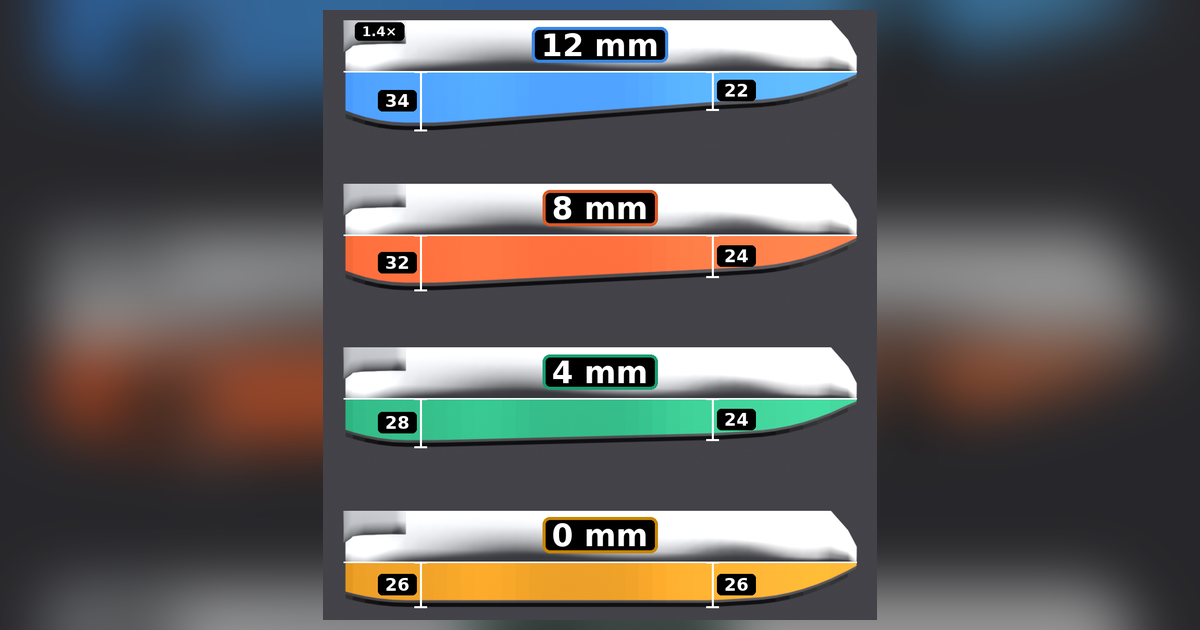
The number printed on a running shoe box — 8 mm, 4 mm, 0 mm — is the drop. It gets talked about as if it decided whether you get injured. The research says something much more modest, and much less certain. This page is the long version of the video: what drop is, what it changes, what it does not, and how confident anyone can honestly be.
The short answer: drop barely changes how you run. It can shift a little load between your knee and your calf and Achilles. And there is no clear evidence that any drop causes or prevents injuries — the one trial that tested it found no overall difference.
What drop is
Drop is a subtraction: the height under your heel minus the height under the front of your foot.
These are the four shoes in the video, measured on the models themselves (typical values for real shoes in each category, not any specific brand):
| shoe | heel | front | drop |
|---|---|---|---|
| high drop | 34 mm | 22 mm | 12 mm |
| mid drop | 32 mm | 24 mm | 8 mm |
| low drop | 28 mm | 24 mm | 4 mm |
| zero drop | 26 mm | 26 mm | 0 mm |
Drop is not cushioning
The total height of the sole is the stack, and it is a separate number. A thick, heavily cushioned shoe can be zero-drop, and so can a paper-thin barefoot shoe. In the video, the cushioned zero-drop shoe has 26 mm under the heel and the toe shoe has 7 mm — both are 0 mm drop. So “low drop” does not mean “minimalist”, and a shoe that feels soft can still be low drop.
Does drop change how you run? Barely.
The video shows the same runner in a 12 mm and a 0 mm shoe with the exact same stride. That is a simplification, but a close one.
A 2023 systematic review pooled 12 studies covering drops from −8 to 16 mm. Drop did not change contact time, flight time, stride frequency or stride length.1 The one change with some support is a slightly flatter landing — a bit more toward the midfoot — in 0 mm shoes compared with 8–10 mm shoes. The review itself calls that evidence controversial.
So “same stride” is the right picture for most runners. If anything changes, it is how the foot lands, and only a little.
Here is what a heel landing and a midfoot landing look like side by side, same runner and same speed:
Where the load goes — this is what drop can change
If the stride hardly moves, why would drop matter at all? Because the same stride can put the load in slightly different places.
More drop → a bit more on the knee
This is the better-supported half. In a lab study, 18 healthy runners ran in 0, 5, 10 and 15 mm shoes. Peak stress behind the kneecap (patellofemoral joint stress) was more than 15 % higher at 10 and 15 mm than at 0 mm, mostly because the knee had to work harder to straighten.2 The 2023 review found the same direction in some studies — not all.1
What that study does not show: it measured one session, in healthy runners, in a lab, with the stress computed from a model. It did not follow anyone long enough to see whether they got hurt.
Less drop → a bit more on the calf and Achilles
This half is plausible but weakly proven inside the normal 0–12 mm range. Studies that compare one drop with another directly are mixed: one found no difference in the calf’s peak effort between 0 and 10–15 mm; another found a difference only in women, and only in part of the stride. The clearer evidence comes from more extreme cases — a computer simulation of a minimalist shoe with negative drop (−8 mm) versus +9 mm found more force in the calf and Achilles,3 and forefoot landings load the Achilles more.4
About the arrows in the video
The arrows are drawn big and in two sizes so you can see which way the load moves. Their length is not a measurement. The real differences are small — the 15 % above is one of the larger effects reported, and it comes from one lab study.
Does drop cause or prevent injuries? There is no clear answer.
This is the part to read carefully, because it is where drop gets oversold the most.
The 2023 review found only one randomised trial that tested it.15 553 leisure runners were randomly given standard cushioned shoes with a 10, 6 or 0 mm drop and followed for 6 months.
Overall, drop made no difference to injury risk. That is the trial’s main result, and it is why the video says “No best”.
The video also shows a split — Runs rarely in 0 mm, Runs often in 12 mm. That comes from the same trial’s secondary analysis:
- Occasional runners (running weekly for less than 6 months of the year) had fewer injuries in the low-drop shoes (0 and 6 mm) than in the 10 mm shoe.
- Regular runners had more injuries in the low-drop shoes.
Why this is not 100 % sure — far from it
- It is one trial. We know of no other randomised trial that has repeated it, so the result has never been confirmed.
- The split was a secondary question. The researchers planned it in advance, which helps — but cutting 553 runners into two groups leaves far fewer injuries in each, and subgroup findings often vanish when someone tests them again.
- The occasional-runner result is borderline. It rests on 150 runners, 33 of whom got injured, and its confidence interval runs from a 77 % lower risk to a 2 % lower risk (hazard ratio 0.48, 95 % CI 0.23–0.98). The top of that range almost reaches “no effect at all”.
- The shoes do not match the video’s. The trial’s “low drop” grouped 0 and 6 mm together, and its high drop was 10 mm, not 12.
- The runners do not match everyone. Leisure runners, standard cushioned shoes, 6 months. It tells us little about racers, trail runners, or anyone in a minimalist shoe.
The honest summary: nobody knows which drop gives more or fewer injuries. The best trial we have found no overall difference, and a hint that the answer might depend on the runner. Treat that hint as a question, not a rule.
”Sore knee? Less drop. Sore Achilles? More drop.”
The video’s advice beat follows the load shift above. It is a reasonable idea, not a proven treatment, and the two halves are not equally backed:
- Knee. The authors of the knee study concluded that drops above 5 mm are “not recommended” for preventing kneecap pain.2 That is an extrapolation from healthy runners in a lab, not a trial in people with knee pain.
- Achilles. The closest evidence is not about shoes at all but about heel lifts — inserts that raise the heel, which is the same as adding drop. In a trial of 100 people with Achilles tendon pain, heel lifts reduced pain and improved function more than calf exercises at 12 weeks — but the authors note the estimate is uncertain and the difference may not be large enough to matter to patients.6
If a pain lasts more than a couple of weeks, or gets worse when you run, see a physio. A shoe change is not a diagnosis, and the same knee or Achilles pain can have very different causes.
Changing drop? Change slowly
This is the one piece of advice nobody disputes. Going from a 12 mm to a 4 mm or 0 mm shoe asks more of your calves and Achilles, so step down gradually — 12, then 8, then 4 — and mix the new shoe into short runs first rather than switching overnight.
Stronger calves make the transition easier. Two moves, bodyweight first, then loaded:


See it move
The video measures four shoes, runs the same stride in two of them, and shows where the load goes.
References
This article is general information about running shoes, not medical advice.
Footnotes
-
Heel-to-toe drop of running shoes: a systematic review of its biomechanical effects. Footwear Science, 2023;15(2). doi:10.1080/19424280.2023.2180542 — 12 studies, drops from −8 to 16 mm. No change in contact time, flight time, stride frequency or stride length; a shift toward a flatter landing only between 0 mm and 8–10 mm shoes, described as controversial; a larger knee extension moment with higher drops in some studies. ↩ ↩2 ↩3
-
Zhang et al. Gait & Posture, 2022. PubMed 35183841 — 18 healthy runners, 0 / 5 / 10 / 15 mm drop. Peak patellofemoral joint stress more than 15 % higher at 10 and 15 mm than at 0 mm (p = 0.001–0.003), mainly through a larger knee extension moment. Single session, laboratory, model-computed stress, no injury outcome. ↩ ↩2
-
Musculoskeletal simulation of running in a minimalist (−8 mm) versus a conventional (+9 mm) shoe. PMC10178672 — higher gastrocnemius and Achilles tendon force in the minimalist condition. A simulation, and a drop outside the 0–12 mm range of the video. ↩
-
Study of footwear and foot-strike effects on Achilles tendon loading (2025). PMC12226555 — forefoot striking raises Achilles tendon load. ↩
-
Malisoux L, Chambon N, Urhausen A, Theisen D. Influence of the Heel-to-Toe Drop of Standard Cushioned Running Shoes on Injury Risk in Leisure-Time Runners: A Randomized Controlled Trial With 6-Month Follow-up. American Journal of Sports Medicine, 2016;44(11):2933–2940. doi:10.1177/0363546516654690 — 553 runners, 10 / 6 / 0 mm, 6 months. Overall no difference in injury risk (6 mm: HR 1.30, 95 % CI 0.86–1.98; 0 mm: HR 1.17, 0.76–1.80, both vs 10 mm). Secondary analysis by running regularity: low drop (0 + 6 mm) HR 0.48 (0.23–0.98) in 150 occasional runners (weekly running < 6 months per year; 33 injured) and HR 1.67 (1.07–2.62) in 403 regular runners (103 injured). ↩
-
Rabusin CL, Menz HB, McClelland JA, et al. Efficacy of heel lifts versus calf muscle eccentric exercise for mid-portion Achilles tendinopathy (HEALTHY): a randomised trial. British Journal of Sports Medicine, 2021;55:486–492. Monash University record — 100 adults, heel lifts vs eccentric exercise; heel lifts better on the VISA-A score at 12 weeks, with the authors noting uncertainty in the estimate and that patients may not experience a clinically worthwhile difference. ↩